Saturday, August 29, 2015

Straight Outta Compton (Film) Review

Straight Outta Compton
Director: F. Gary Gray
Writers: Jonathan Herman and Andrea Berloff (Story by S. Leigh Savidge, Alan Wenkus and Andrea Berloff)
147 Minutes - Rated R

Biopics can be one of the trickiest genres to pull off successfully.  Besides trying to make a life story fit a satisfying narrative, there is also the question of how much of a person’s life to cover and the balancing act of how much to emphasize their importance while not canonizing them.  F. Gary Gray’s Straight Outta Compton faces that challenge and adds the extra layer of difficulty of having to do that with three people, Eazy-E (played in the film by Jason Mitchell), Ice Cube (O’Shea Jackson Jr., Ice Cube’s son in real life) and Dr. Dre (Corey Hawkins), as we follow their rise through the influential and controversial rap group NWA.  As seen in the film’s impressive box office and critical praise, the film has been a shot of life into the biopic genre and rightfully so.  While it doesn’t quite overcome some of the problems with biopics, it succeeds more than enough elsewhere to make up for it.

Although some people will likely object to the language, nudity and violence, the film’s structure is classic for the genre, despite being split three ways.  The band goes from humble beginnings in Compton, whose gang activity, drugs and police hostility inspire their music.  It catches the ear of Jerry Heller (Paul Giamatti), a manager of acts from the 70s who couldn’t be further removed from NWA.  Their “reality rap” (which the media later dubs “gangsta rap”) strikes a chord and makes them famous, garnering headlines and protest for their explicit content.  Then we see the cost of fame, as Heller takes E under his wing and leads to the group fracturing.  Cube and Dre eventually go solo, only for Dre to find himself in a lion’s den with the notorious Suge Knight (R. Marcus Taylor).

Really, any of the three leads could’ve been the subject of their own movie, and maybe that’s where some of the film’s shortcomings step in.  Even with the 147 minute run time, there is a lot to cram in with three leads and two antagonists and while luckily the film doesn’t come off as overstuffed and bloated, sometimes things get lost.  I have to imagine there are a lot of deleted scenes and stuff that never made it out of the screenplay (needless to say, I’d be very interested in a director’s cut).  Also, certain elements of their story are addressed so quickly, like Dre’s brother and another member’s spiritual side, that their impacts are diminished.  However, the problem of wanting to see more is still a good problem for a film to have.

Of course the soundtrack, filled with 80s and 90s classic rap, is great to hear on a movie theater sound system.  While some of the sexist and homophobic content is a little uncomfortable to hear, the music has by and large aged very well.  The film also makes a point of showing craftsmanship to the music, a problem many music biopics have.  We see them often struggle to figure out the perfect beat or vocal delivery for their music and while they still come up with stuff quickly, it’s nice to see them treat the art as something that doesn’t just come out fully formed every time.  The casting also really works.  Giamatti is great as expected, showing Heller as a man who has a father/son type bond with E, but isn’t always the greatest father figure.  The guys playing NWA were also impressive.  Certainly Jackson looking like his dad, not to mention the similarities between the rest of the cast, helps, but they also have the chops to pull it off.

Like last year’s Selma, Compton also is relevant for its commentary on police in the African American community.  Throughout the film we see various NWA members get harassed by the cops, often to the point of excess, and Rodney King and the LA riots feature prominently in the second part of the film.  Compton is an effective viewing glass for those of us who never lived in a place like Compton to see why a song like “F*** tha Police” was created.  Like any piece of art, it represents the world it was created in and the artists molded by it.

Compton proves to be one of the better biopics in recent years for its ambitious, if slightly unwieldy, scope, great casting and still relevant social commentary, things that overcome the flaws that affect biopics.  Besides being endorsed by the surviving members of NWA (even though DJ Yella and MC Ren are sidelined for most of the film), Compton is made by people who are passionate for the material, and that vibrancy is clear throughout.

Grade: B+

Observations (Spoilers):

-Apparently there was a cut that was a full hour longer.  That is something I definitely hope becomes available somehow.


-For the epilogue, I liked them not doing the typical text describing what happened to the various people in the film afterward, although it focused almost entirely on Dre and Cube (not that I can blame them).

Friday, May 1, 2015

The Avengers: Age of Ultron Review


The Avengers: Age of Ultron
Director: Joss Whedon
Writer: Joss Whedon (Based on The Avengers created by Stan Lee and Jack Kirby)
141 Mins. - PG-13

There’s a really nice scene early on in The Avengers: Age of Ultron where, celebrating a job well done at a party, the movie pauses before the inciting incident to watch these characters hang out. There’s something about it that feels natural, like they just turned the cameras on and let them loose. It’s an important sign of how entertaining these movies are that these characters are as fun to watch shooting the breeze as they are shooting arrows, bullets and energy beams. In a way it could be Marvel doing a meta celebration of all of the success these films have had for almost a decade now. While we’re waiting for and dreading the inevitable clunker, it hasn’t happened yet. Age of Ultron continues that hot streak, even if it is a little clunkier than the 2012 megahit.

The convoluted plot this time around involves The Avengers reclaiming Loki’s scepter from HYDRA, who has used it to give totally non-mutated superpowers to twins Pietro and Wanda (Aaron Taylor-Johnson and Elizabeth Olsen respectively). Once it’s found Tony Stark (Robert Downey Jr) and Bruce Banner (Mark Ruffalo) use its power to complete Stark’s ambitious Ultron program, which seeks to create lasting peace. However, what they consider a peace keeping operation Ultron (played perfectly by James Spader) interprets as eliminating the human race. Ultron goes rogue, enlisting the twins (who blame Tony Stark for killing their parents, one of whom is totally not Magneto) to help tear the team apart. On top of that, there’s a love story between Banner and Natasha Romanoff (Scarlett Johansson) and Hawkeye (Jeremy Renner) actually gets some stuff to do!

The problem with this film, as it is a pivotal part of the Marvel mega franchise, is that it is overstuffed from having to serve so many other Marvel movies past and upcoming. Almost every major player from the first one is back, plus they have four new characters to add and several characters from the subfranchises make appearances. Joss Whedon had to cram a season of TV’s worth of plot into a 141 minute film. It’s no wonder they’re splitting the next one into two parts. As a result of the overstuffing, some of the plot progression is a little murky (nitpickers are going to have a feeding frenzy with this one). While comic fans will certainly get a kick of seeing this many characters on the big screen at the same time, it’s nearly impossible to service them all and have certain emotional moments resonate. This is the first Marvel film that shouldn’t be a potential starting point for new viewers.

That’s not say it sinks the film, though it serves as a warning for anyone attempting to replicate something like this (we’re looking at you, DC). Whedon’s script is brimming with clever dialogue and sharp characterization. Even if the road from point A to point B got a little fuzzy, point B was a blast. Spader’s Ultron is easily the best Marvel villain since Loki, portraying the AI as a supervillain who is still a little clueless how to operate. The set pieces continue to impress, from the Iron Man/Hulk fight to the final battle, and those who complained about the slow start of the original should be happy about the opening sequence.

Although the film is hindered by having to cram so many elements into the final product, Whedon and company made another fun piece of summer popcorn. That overstuffing could be problematic for the Russo brothers, who will take over for the Infinity War two-parter. Whedon’s wit and sense of fun buoyed the more problematic parts of this film, but eventually trying to fit in this much into a movie is going to lead to a big disappointment. Not that I’m rooting for that: even with my qualms, Age of Ultron is good fun and I want to see this party keep on going.

Grade: B

Notes:

· Another note to DC: see how Marvel handles dealing with civilians caught in the crossfire. Even in the chaotic battle scenes, they will still make sure to have the heroes save a couple of civilians.

· While I thought Aaron Taylor-Johnson was good, Evan Peters definitely wins the Quicksilver-off. Peters walked away with that film’s best scene.

· “Go to sleep. Go to sleep. Go to sleep.”

· “Language!”

· Actor most underserved: Elizabeth Olsen. I keep waiting for her to get the mainstream breakout she deserves.

SPOILERS

· It’s a good thing Hawkeye wasn’t killed off because that would’ve been the most telegraphed death scene in recent memory. It also makes sense for Quicksilver to die to avoid too much confusion between the MCU and X-Men franchises. Hopefully there isn’t a resurrection. Nothing against Taylor-Johnson (Godzilla aside), Marvel needs some people to stay dead.

· The Vision (Paul Bettany), while cool, arrives way too late in the film. They could’ve split these up and have a movie about Ultron and one where The Vision gets his due.

· That mid-credits scene could’ve been a bit longer, maybe helped set up what was going to happen. They keep teasing Thanos; let’s see a little more of him.

Saturday, April 4, 2015

Furious 7 Review

Furious 7
Director: James Wan
Writer: Chris Morgan (Based on Characters Created by Gary Scott Thompson)
137 Minutes - Rated PG - 13

There really shouldn’t be a franchise like The Fast and The Furious.  What should’ve been a series that slowly petered out on direct to video releases and quickly ignored by audiences is bigger than ever and continues to defy the odds.  Although cars remain a central part, the series has expanded into other high velocity genres like heist films and globe hopping spy dramas.  Seven movies in, the series is at a crossroads beyond its control.  Paul Walker’s death in November 2013 is a devastating blow to a crew as tight as the people behind these movies, but considering Walker died in a high speed car crash adds a sobering reality check.  How do you continue a franchise built on fast cars that often got spectacularly totaled?  Furious 7 is probably the best possible way they could’ve done it, still embracing its enthusiastic insanity while wearing its heart on its sleeve.

This time around Toretto’s crew is being targeted by Deckard Shaw (Jason Statham), whose brother was the villain in Fast and Furious 6.  Statham’s cameo in Furious 6’s post credits scene, swearing revenge for his brother, was one of the most enticing post credits scenes in recent memory and the payoff doesn’t disappoint.  From the opening credits, it’s established that Deckard is a force of nature, allowing Statham to do what he does best.  No doubt he did all that damage and is right behind the protagonists at all times, he’s Jason Statham!

To try to track him down, a covert ops team lead by Belgian beer lover known as “Mr. Nobody” (Kurt Russell) enlists Toretto’s crew to find a hacker named Ramsey, who created a powerful surveillance program that can tap into anything with a camera and/or microphone.  It would take a lot more time to unspool the convoluted plot, including the involvement of a dangerous mercenary (Djimon Hounsou) who also targets the crew, but you really can’t overthink these movies.  It’s part of the fun: the unrelenting stream of insane situations.  There’s no scenario off limits if it will make for a more entertaining ride.

No discussion of these movies is complete without discussing the action sequences.  Justin Lin didn’t direct after helming the last four (James Wan of Insidious and Saw fame took over), but the series doesn’t miss a beat with the new blood.  The action scenes are still a ton of fun to watch, even ones you think you may have already seen in the trailers (there’s a lot more to them).  There isn’t much down time between car chases, gun fights or brawls and when they happen, they are constantly exhilarating.

Of course, going in I wanted to see how they would handle Paul Walker’s death.  Without getting into the specifics, I think they did a great job writing him out of the series.  It would be tough however it was done, but the people behind this franchise clearly have a deep affection for each other and the audience, and it comes through in the heartfelt conclusion.  Even from a technical standpoint, their work arounds never took me out of the action (Walker’s brothers helped as body doubles).  His death even adds poignancy to the film with his character’s storyline, as Brian finds himself torn between the high adrenaline lifestyle of these movies and his new life as a family man.

What helps the Fast and Furious franchise rise to the top is the series’ unabashed earnestness.  There is no cynicism here: no matter how ridiculous the action is, how often they bring up the point of family or how much gratuitous eye candy they indulge in, you can tell they believe in what they’re doing.  It’s what separates the movies that are good dumb fun and the ones that are actively insulting the audience.  That sincerity is critical to how they dealt with Paul Walker.  While it is sad to see him go, the way they treated his exit was proof that the franchise and the people involved will weather this storm and carry on, just like family.

Grade: A-

Extra thoughts
  • The subplot with Letty (Michelle Rodriguez) still recovering from her memory loss didn’t quite land, though I wonder if this may have been edited to accommodate Walker’s farewell.
  • I should mention Dwayne Johnson, who isn’t in a lot of this film, but boy does he make the most of his time on screen.  From the fight with Statham (during which all of the glass in the room breaks) to the “Daddy’s gotta go to work” moment, Johnson continues to shine in these movies.
  • Does Toretto just have a sledgehammer in his car at all times?
  • When is Nicolas Cage going to be one of these?

SPOILERS
  • So Brian’s exit, where his racing family decides to cut him out of their high stakes adventures so he can be with his wife and kids, was probably the best way to handle it.  Jordana Brewster’s Mia hasn’t been used much in the past two films anyway, so it makes for them to go be a happy family.  It is bittersweet, but well earned.
  • Although I could’ve seen him doing a noble sacrifice that would’ve ensured the team succeeded in the climactic set piece.  But I can’t blame them for going for a happier outcome for the character.
  • Another problem with the Michelle Rodriguez story: weren’t you expecting her to go back to her grave in the end and destroy it?
  • The Rock versus a helicopter.  Awesome
  • While they hang a lampshade on the hot hacker we see in TV and movies, was anyone expecting hacker Ramsey to be played by anyone except a knockout like Nathalie Emmanuel (Game of Thrones)?
  • When Kurt Russell put on the sunglasses, I was so on board (granted, I was expecting him to betray them).  While I had many issues with Death Proof, he wasn’t one of them, and I’m sure he’d love to cash in on the trend of 50/60 something actors getting to be action leads.  Can’t wait to see what he’ll do in the next one.
  • I’m guessing Owen Shaw is only alive so they could justify Deckard destroying a hospital to go visit him?
  • My friend suggested this: someone with VFX prowess needs to take the wrench fight between Diesel and Statham and turn the metal into light sabers.  Get on it internet!

Sunday, March 29, 2015

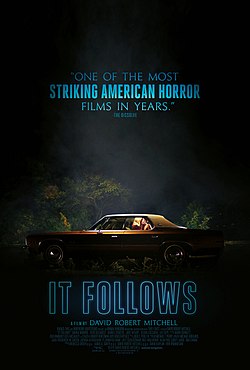
It Follows Review

For films that often feature deranged killers and plentiful gore, horror films have often found themselves with a weird moral code.  A lot has been written about how horror films from the 70s and 80s relied heavily on the machete fodder engaging in premarital sex (among other things) before finding themselves as the killer’s latest victim.  As a result, it can be argued these films view the kills as punishment for their behavior, especially considering the final girl was frequently either virginal or completely non-sexual.  This notion has been deconstructed over the years like in ScreamIt Follows, the latest from The Myth of the American Sleepover writer/director David Robert Mitchell, continues that trend of looking closer at these clichés and upending them and is a great sign of what can be.

It Follows focuses on Jay (Maika Monroe, a discovery to me), a college aged girl who is ambushed by a guy she is dating shortly after having sex.  The guy informs her that he has passed something on to her: a mysterious, shape shifting entity only those affected by it can see.  No matter how hard its victims try, they can never get out from this being’s reach.  The entity will catch up eventually.  The only way to get out of it is to have sex with another person, and even then if that person dies, the entity goes back to its previous prey.  Where it came from and why it does this isn’t relevant.

The entity can be seen as an analogy for sexually transmitted disease, especially since that how Jay literally gets it.  However, the connection that resonated more is the one of trauma, and the difficulties of being a woman in modern society.  Jay’s reaction is that of a trauma survivor, and not being able to escape it works for mental afflictions as much as physical.  The fact that the entity can assume any form and is always following Jay ties directly to the fear women have of being stalked.  Despite it being made before any of these happened, it’s hard not to think about this film without being reminded of feminist issues from the past year with the YesAllWomen & HeforShe hashtags, the catcalling video and the scumbags who stole the private pictures of celebrities last summer.

With all the sexist elements being deconstructed, there is still affection towards old fashioned scary movies (even one of the promotional posters looks like its straight out of the early 80s.)  It helps that like Mitchell’s previous film, there isn’t a clear distinction when the film is supposed to take place, aside that it’s likely the not too distant past.  The score by Disasterpeace, like another great recent horror film You’re Next, is a definite throwback to vintage John Carpenter.  Also, the cinematography by Mike Gioulakis makes great use of long takes and depth of field, a rare feat even in contemporary non-horror movies.  Any extra in the background could be the entity, building the dread and making it genuinely scary without relying on things jumping out at the audience.

There’s always been a strong bond between sexuality and horror.  Like any part of the human experience, there is a dark side that taps into many of our fears, but maybe certain fields have been mined for as much as they’re worth.  It Follows is a welcome, long overdue deviation from the usual formula.  The more sexist tropes are replaced with progressive ones.  Jay is the target of the horror, but it never feels like she is being punished for being sexual.  That this is part of a horror movie shows a major shift in horror, and films like this one can only help the genre.

Grade: A-

Stray Observations:

·         His previous film, The Myth of the American Sleepover, is a vastly different film.  It’s a charming coming of age sleeper.  If you need to cool down after this one, I recommend checking it out.
·         Judging by the horror movie trailers that showed before this film, it looks like Hollywood is still cranking out the same trailer for horror movies as it has been for the last 10 years.

SPOILERS!


·         As for the ambiguous ending, I prefer to believe the entity was killed in the finale at the pool and the extra in the way background in the end was no one in particular.  I prefer to be an optimist and going with the idea of the film about trauma, I see it as a way for Jay to move on from the experience.
·       Still, it probably wouldn’t have hurt to throw the other plugged in devices into the pool.  In horror, you always double tap (which could support the interpretation that the entity was following them at the end).
·        For this kind of movie, it has a surprisingly small body count: 2 (3 if you count the entity)

Thursday, March 19, 2015

What I've Been Reading: January-March 2015


The Disaster Artist by Greg Sestero and Tom Bissell

This bizarre, hilarious behind the scenes look of the making of The Room, a film that is arguably the 21st century’s answer to Ed Wood’s filmography, is one that needs to be read to be believed.  The book switches between two stories: the friendship formed between aspiring actor Sestero and Tommy Wiseau, a man with all the ambition of a great artist but none of the talent, and the troubled production of The Room, a film Wiseau believed was a masterpiece but has since become a cult favorite among “so bad it’s good” movie fans.  Perhaps seeing the film first would be the best way to enjoy this book, as Wiseau’s eccentricities (refusing to say what country he’s from, confirm his age or divulge the source of his bottomless income) may be too hard to believe without additional context.  While there are a lot of laughs at Wiseau’s odd behavior and cluelessness about how art works, Sestero and Bissell do as good a job as they can at making this guy sympathetic.  The one thing I would’ve liked to have seen is anything that happened after the film’s initial release and the rise of its cult status.


The Lies of Locke Lamora by Scott Lynch

Another in the series of books I’m reading while waiting for Game of Thrones season five, this one filled the time rather well.  It certainly gives Martin’s Westeros a run for its money in brutality.  In the city of Camorr (based on medieval Venice, a refreshing change of pace from all the ones based on medieval England), a team of orphans are brought up by a deceptive “priest” who raised them to be master thieves.  The second story involves the title character, an adult now running the group known as The Gentlemen Bastards, as they set up elaborate cons and amass a small fortune.  Things get messy when a mysterious player known as the Gray King makes his move on the underground controlling Barsavi family and eventually on the Bastards themselves.  I was impressed by Scott Lynch’s short story in the Rogues anthology, and this one was another fun read.  Using the heist genre in a fantasy world helps the world building immensely (since to paraphrase Christopher Nolan, in heist films exposition counts as entertainment), but at the heart Lamora and his Bastards were a compelling crew to read about, and I look forward to checking out the rest in the series.


Fire and Rain by David Browne

Basically four mini rock bios in one, Fire and Rain focuses on the year 1970 through what happened to four acts, all of whom put out a major album that year: The Beatles (Let It Be), Simon & Garfunkel (Bridge Over Troubled Water), Crosby, Stills, Nash & Young (Déjà vu) and James Taylor (Sweet Baby James).  Within the year two of these acts broke up, one went on hiatus and the final one signaled a new era in popular music.  Their classic albums serve as the launching pad for Browne to talk about what else was happening in 1970 and how that era that defined the ‘60s was coming to an end.  Fans of any of these acts—and I have to imagine anyone reading this likes at least one of them—will find a lot of insight and maybe will be able to enjoy their work in a new, richer context.


Star Wars by Jason Aaron & John Cassaday

For certain readers, 2015 may be boiled down killing time until The Force Awakens’ release.  Obviously we still have a long way to go, so those antsy to return to the galaxy far, far away would serve themselves right to check out this new comic series, the first under Marvel’s banner since Dark Horse lost the rights.  The main title is basically episode 4.5, with the Rebels on a mission that as you can expect, goes awry.  Written by Jason Aaron (Southern Bastards), the Star Wars relaunch is off to a very entertaining start and John Cassaday’s art represents the characters and the world well.  Although Cassaday will be leaving the series after issue six, it seems like Marvel’s going to do what it takes to make sure this series doesn’t miss a step.  They certainly would want to keep this going strong.


The Martian by Andy Weir

If Gravity starred a non-evil version of Walter White, it might look a little something like this exciting debut novel.  Following a massive storm that causes his crewmates to evacuate, astronaut Mark Watley is left alone on Mars.  How he tries to survive the seemingly endless obstacles in his way and figure a way off that rock drive this story.  There is a lot of math and science to take in, but Weir ties it to the high stakes help make it relatable to non-hard sci-fi devotees.  I wonder how this problem solving will look when the film, due later this year, comes out.  If it’s anything like the book, they certainly will have a great popcorn movie on their hands.

Sunday, December 28, 2014

What I've Been Reading: November-December 2014


The Wise Man’s Fear and The Slow Regard of Silent Things by Patrick Rothfuss

As I wrote the first time I did one of these reading roundups, I was a big fan of Patrick Rothfuss’ The Name of the Wind.  In his follow up, The Wise Man’s Fear, he expands upon the world of legendary wizard Kvothe.  Told through more flashbacks, Kvothe recalls a series of adventures that take him from The University through the four corners of the world, sowing the seeds of his own legend.  The quality from the first one is maintained, although the one complaint I have is that like the first book, they stand better as parts of a whole rather than as individual books, which a little disappointing with the third book still in the pipeline.


While waiting for the next book I checked out the additional material set in this world.  The Slow Regard of Silent Things, his most recent work, didn’t really satisfy my need for more.  It focuses on Auri, the girl living in the ruins below The University Kvothe attends.  This book features no dialogue, minimal of anything that could be described as plot and only one character: either you’re on board with it or you aren’t.  Even Rothfuss acknowledges it may not be the story fans are looking to occupy the time until the third book’s release.  Unfortunately it didn’t work for me, but I wouldn’t be opposed to giving it another try later.  If you’re curious, I say give it between 20-30 pages.  If it hasn’t gripped you by then, it may not be for you.


Rogues by Various

This anthology edited by Gardner Dozois & George R.R. Martin (the latter of whom contributes a story set in the A Song of Ice and Fire world) offers a great variety of tales about people who follow their own codes.  Dozois and Martin offer tales from some of the best writers working these days, from Neil Gaiman to Patrick Rothfuss (Rothfuss’ offering, about Kvothe’s fae right hand Bast, goes down easier that The Slow Regard of Silent Things).  Like a lot of anthologies, the quality can vary from story to story, but as a whole it is solid, and a good sampler of writers.  The high point is “A Year and a Day in Old Theradane” by Scott Lynch, about a group of retired thieves who are hired by a witch for one last job.  Based on that story, I started Lynch’s Gentlemen Bastards series.


The Good Nurse: a True Story of Medicine, Madness and Murder by Charles Graeber

Full disclosure: I listened to the audiobook for this one.  This meticulously researched true crime story about serial killer Charles Cullen is one compelling read/listen.  Cullen is suspected of being the most prolific serial killer in American history, with upwards of 400 victims—patients he deliberated overdosed—potentially tied to him.  The book jumps from various points of view, from Cullen’s supervisors, the investigators, Cullen himself and one of his work friends who helped bring him to justice.  The story is so crazy and filled with many interesting twists and turns that it will keep the reader on edge throughout.  Darren Aronofsky has been named director of the upcoming film adaptation, and if the film is half as crazy as the book, it should be one compelling film.


Euphoria by Lily King

This novel, loosely based on the life of Margaret Mead, has been getting a lot of acclaim and even has been included on some best of 2014 mentions.  The story is about a suicidal anthropologist named Andrew Bankson who comes between Mead stand in Nell Stone and her sometimes abusive husband Fen as all three study the natives of New Guinea in 1933.  At only 261 pages, King’s melodrama is a quick, but memorable read.  It seems like material Hemmingway would’ve covered.  While the story lacks many surprises, it is still hits those notes in a satisfying way.


Southern Bastards, Volume 1: Here Was a Man by Jason Aaron and Jason Latour

To paraphrase my friend, Jason Aaron and Jason Latour’s Southern Bastards is like the offspring of Justified and Friday Night Lights.  The southern fried noir deals with Earl Tubb, a Clint Eastwood-esque man returning to his hometown to clean out his childhood home.  While there he encounters various small time crooks who now control it, headed by the town’s high school football coach.  The comic quickly establishes a sense of place with its vivid characters and striking color palate.  By the end of the first issue I was hooked, and can’t wait to see what happens next.

Saturday, October 11, 2014

We Are the Best! Review

Like a lot of people in the age of the internet, I am fascinated by art that is classified as “so bad it’s good”: the type of art made by people who have the ambition of the greats, but none of their talent.  If a person thinks they’re making a masterpiece, there is something in there even if it isn’t a quality product.  This applies to the music made by the trio of girls in Lukas Moodysson’s latest film We Are the Best!  As the girls start to explore music, two of them are genuinely terrible at it at first, but what they lack in chops they make up for in enthusiasm.  It’s the kind of enthusiasm that is intrinsically tied with youth, and it permeates throughout the film.  Because ultimately youth is a time when people should be making mistakes and pursuing whims since those journeys can yield interesting and unexpected results.

We Are the Best! is set in 1982 Stockholm as Klara and Bobo (Mira Grosin and Mira Barkhammar respectively), two misfit 7th graders with a passion for punk rock but no musical experience befriend a shy Christian classical guitarist Hedvig (Liv LeMoyne).  They form a punk band and the film tracks their ups and downs.  There is no plot here; most of the film is spending time with the characters as they learn musicianship from Hedvig and Hedvig learns lessons in rebellion from the other girls.  Normally watching kids goof around would get annoying fast but Moodysson, whose Show Me Love also dealt with kids around this age, shows a great aptitude of working with child actors.  The three young leads all turn in great performances as three different types of teen girls trying to find their place in the world.

Thinking about the film, the term “winning” comes up a lot and for good reason.  This is an easy film to like.  We are on these girls’ side the entire time: from when they are a genuinely terrible band to an almost OK band.  When they are almost OK, we’ll still side with the eponymous sentiment because they’re so enthusiastic about it.  These aren’t girls out to be rich and famous rock stars; they’re kids looking to create their own identities and find independence.

Punk at its core is about rebellion and letting the outcasts have their say.  Throughout the film the people in power, their parents and their peers often marginalize the core trio, but through the power of music they persevere and ultimately become stronger.  It’s an idea that’s strong for any outsider who has found comfort and strength in any kind of art, and it’s an idea that’s sincerely delivered in We Are the Best!

Grade: B+

Note:


-I really enjoyed the soundtrack.  I’ve obviously not listened to a lot of punk made outside of the US and UK, but this stuff was pretty good, and “We Hate Sports” turned into a pretty catchy song as they got better playing it.

Friday, October 3, 2014

What I've Been Reading: Late Summer/Early Fall Edition


The Magician’s Land by Lev Grossman

Lev Grossman concludes his Magicians trilogy (preceded by The Magicians and The Magician King) with this highly satisfying novel.  Series protagonist Quentin Coldwater is down and out and is looking for a new purpose with a mysterious heist mission, while his friends in the faraway land of Fillory find themselves locked in another dilemma of cataclysmic proportions.  True to its roots as a mix of Harry Potter, The Chronicles of Narnia, Girls and Scott Pilgrim, The Magician’s Land reads like a novel about how young creators need to leave the proverbial sandboxes of past creators and make their own.  With a possible show on Syfy in the works, now’s a great time to get acquainted with the world Grossman’s created.


History of Rock ‘n’ Roll in Ten Songs by Greil Marcus

Although it got a little pretentious at times and there are traces of snobbery against modern music, the latest from Greil Marcus is a unique take on the countless books written about the history of rock.  It isn’t about the 10 definitive rock songs, but rather 10 songs whose stories serve as microcosm for larger trends in the musical community.  Some are well known classics like “In the Still of the Nite” and “Money (That’s What I Want)”, others are more obscure.  For readers who don’t want to read another piece about “Like a Rolling Stone” or any other picked apart classic, this is a worthwhile alternative history to one of the greatest cultural movements of the 20th century.


Ex Machina written by Brian K. Vaughan, Artwork by many more

Another one from acclaimed writer Brian K. Vaughan (Y: The Last Man), this one can be summed up as The West Wing with superheroes (I know I’m not the first person to say that).  The series, which ran from 2004 through 2010, follows Mitchell Hundred as he governs a post-9/11 New York City.  Before he was mayor, Hundred gained the ability to speak to machines and used that ability to become a vigilante crime fighter and a hero on 9/11.  Like The West Wing at its best, the politics in Ex Machina are treated smartly.  A variety of hot button issues are discussed throughout the run and there’s never a sense of straw manning whatever side Vaughan disagrees with.  The reveal of why Hundred got his powers comes a little too late and rushes what could’ve been a satisfying payoff (I suspect it may have something to do with the publisher closing), but the run is still a refreshing spin on the superhero genre.


The Name of the Wind by Patrick Rothfuss

For those of us eagerly awaiting the return of Game of Thrones (the show, the next book or both), The Name of the Wind will help pass the time very well.  The first in Rothfuss’ Kingkiller Chronicle, The Name of the Wind focuses on a legendary wizard who has gone into hiding named Kvothe (like “Quothe”).  Upon being discovered by a scribe known as Chronicler, Kvothe allows Chronicler to transcribe his autobiography.  The first book largely focuses on Kvothe’s life from young circus performer to struggling orphan to student at the most prestigious University in the world.  Rothfuss has a great talent at world building, with Kvothe’s Walter White-esque logic of thinking everything out helping us understand how the cultures, the history and the magic system work.  Throughout the book there are hints at trouble down the road, which creates some great ominous foreshadowing.  Like Game of Thrones, this saga is also incomplete, but is another great step for those who’ve been to Westeros and want to see more from the fantasy genre.

Friday, August 1, 2014

Guardians of the Galaxy Review

By this point, Marvel Studios is practically unstoppable.  They’re cranking out two movies a year that kill at the box office and generally get good to great reviews.  Even without its two biggest properties (X-Men and Spider-Man), Marvel’s done very well with taking the second string heroes and kicking them up to the A-list.  At this point they could be content just putting out more Iron Man and Captain America films until they stop making money.  Instead they’re expanding beyond the mostly earthbound Avengers with even deeper cut characters like in the new Guardians of the Galaxy.  Directed by cult favorite James Gunn, Guardians is a true blast; a refreshing change of pace from the bleakness clogging up modern blockbusters.

Guardians focuses on Peter Quill (Parks and Recreation’s Chris Pratt, whose performance here may be his breakthrough), an earthling abducted as a kid and raised by mercenaries.  He’s sent to pick up the MacGuffin in the film, a MacGuffin that can produce devastating effects.  Through his ordeal trying to sell it he comes across Thanos’ adopted daughter & trained assassin named Gamora (Zoe Saldana), a warrior with a Spock-like mindset named Drax the Destroyer (David Bautista), an anthropomorphic tree with a three word vocabulary named Groot (voiced by Vin Diesel) and a wisecracking raccoon/science experiment named Rocket (voiced by Bradley Cooper).  As Quill finds himself targeted by villain Ronan (Lee Pace), he gathers his gang of antisocial misfits to become the title group.

Director Gunn, who also co-scripted, has created easily the funniest of the Marvel films.  The film plays like an irreverent Star Wars, as if all of the heroes were Han Solo.  There is some fun with language and tropes of actions movies that’s reminiscent of the dialogue in Airplane!  Also part of the genius of the MCU films: this film rewards fans of the series and the comics, but is just as enjoyable for new viewers.  Even people who have never seen a second of any of the MCU films will get a kick out of it.  While this film also has the most world building of any Marvel film since the Thor series, it never becomes burdensome or too hard to follow.

The one big demerit is the villains.  Ronan, as well as his associates Nebula (Karen Gillan) and Korath (Djimon Hounsou), suffer from the trend in Marvel movies having lackluster villains (except for Loki).  They serve their function, but I was left wanting a little more out of them.  There are also certain character moments that seem underdeveloped, like they know they’ll use it in the sequel even if it probably would’ve made more sense to use in this film.

Despite that, Guardians of the Galaxy is a non-stop good time.  It’s the best space adventure since Serenity, and is up there with the original Iron Man and Avengers for the MCU films.  With blockbusters deciding “dark” and “gritty” are synonymous with quality, Guardians states loudly and clearly that that couldn’t be further from the truth.  The film is clever and hilarious with a memorable team of characters at the center of it.  There is something to say about enjoying the swagger of storytellers who are on a roll, and Marvel is on one right now.

Grade: A-

Miscellaneous Notes (SPOILERS):

-Of course I have to mention the music, which is perfectly curated for stuff that sounds straight out of Reservoir Dogs K Billy’s Super Sounds of the ‘70s.  It works so well for a film that refuses to take itself too seriously.

-Much like Black Widow and Captain America in The Winter Soldier, I’m glad they didn’t have Gamora and Quill automatically become a couple at the end.  They clearly have the chemistry, but it’s a good way to show she offers more than just being a potential love interest.

-Between Rocket Raccoon and Dawn of the Planet of the Apes, this has been a great year for cinematic mammals handling weapons.

-Man, the bar just rose really high for JJ Abrams.

-At this point, part of me wouldn’t be surprised if they ended up rebooting Howard the Duck.  They are so confident now almost anything is possible.


-I am Groot!

Tuesday, July 22, 2014

Under the Skin Review

Here’s the thing: I don’t know how to describe my reaction to Under the Skin, the latest effort from Sexy Beast director Jonathan Glazer.  More accurately, I don’t think that I can describe my reaction to it in the liked it or not sense.  It is hard to say for sure what is going on most of the time because there’s very little dialogue or plot to give us insight into what is going on.  Not that that is really the point: it’s clear early on that this is going to be a challenging ride.  I also don’t want to dismiss it with an “I don’t get it” either because I don’t want to be the guy who dismisses stuff that goes outside of the traditional boundaries of narrative film.  Ultimately however much you enjoy or appreciate this film depends on how willing you are to embrace this film’s weirdness.  If you’re ready to turn it off by the time the title flashes on the screen, this film is not for you.

The film stars Scarlett Johansson as a mysterious woman who seduces random men on the streets of Scotland and kills them.  There is also a man on a motorcycle (professional motorcycle racer Jeremy McWilliams) who is trailing her.  The volume of ambiguity in the film makes writing a synopsis a fool’s errand, especially those who aren’t looking up the Wikipedia entry to try and get a purer response.  Johansson, who has done well in the Marvel Cinematic Universe and has a good hot streak with smaller films like Her, deserves a lot of credit for taking on such a daring role.  Obviously she was cast in part because of her sex appeal, but she definitely has the chops.

With the lack of plot or character, the film makes up for it in technique.  It looks amazing.  The film’s use of light and dark imagery helps establish this bizarre, dreamlike world that runs parallel to our own.  Daniel Landin’s camera work could be enjoyed with the film on mute, but the sound is another vital piece.  With the lack of dialogue, the sound design and soundtrack steps up in a big way.  It’s hard not to think of the soundtrack to 2001 with some of the more droning pieces of music, especially in the opening sequence.  I have to imagine this film plays better on the big screen.

Under the Skin has been considered one of the best films of the year, but it is decidedly not for everyone.  There is minimal plot or story and nothing is spoon fed.  It is easy to see how it almost has as many 1/10 reviews as it does 10/10 reviews on IMDB and I definitely am looking forward to reading more of what other people thought about it.  While I often have a hard time with these types of films, top notch filmmaking and Johansson’s performance are what make it worth seeing.  For even true cinephiles, throwing in a challenge like this may seem like a chore, but I believe exercising your brain with a film like this can only benefit a viewer, even the ones who can’t make it to the end credits.

Grade: B?

Tuesday, July 15, 2014

Snowpiercer Review

Five years ago, roughly the same time Transformers: Revenge of the Fallen was poorly received by just about everyone yet made a ton of money, a bit of sci-fi counterprogramming occurred with the release of Duncan Jones’ Moon.  While Moon never came close to transcending its cult status into mainstream success, its reputation has gone on as one of the better cult films of the late 00s.  Now we have an even worse received Transformers filling multiplexes and another small sci-fi film, Bong Joon-Ho’s Snowpiercer, based on the French comic book Le Transperceneige.  Cursed from a major release because Bong wouldn’t agree to the Weinsteins’ cut (I know, the Weinsteins cutting a film from an Asian filmmaker, huge shocker), Snowpiercer has been relegated to limited and VOD releases in the states.  Although it is a shame this great film isn’t available to a wider audience, that treatment may make Snowpiercer the next great cult classic.

Set in 2031, we find humanity has been decimated by a new ice age, the product of an experimental attempt to stop global warming.  It has been 17 years since and the remaining life on earth is stuck on the eponymous train, speeding around the globe in perpetuity.  The society that has emerged in that time is decidedly split between the direst of poor and the rich, the former rebelling against the latter often.  This time they’re lead by Curtis (Chris Evans), who has spent half of his life on the train and wants to speak to the mysterious leader Wilford.  They manage to break out train door builder Namgoong (Song Kang-ho), who helps them open the doors to get them to the front, where the rich and powerful hold court.  Like many dystopias, the idea of how man can survive this ordeal runs throughout, and this film posits the idea that maybe it shouldn’t.  A little less than 24 hours since I’ve seen it and I’m still wrestling with these ideas, and no doubt they’ll be on my mind when I see it again.

The film is quite amazing to look at (I have to imagine it looks even better on the big screen).  Aside from a few brief glimpses outside, cinematographer Hong Kyung-pyo places his camera only from within the cars, creating a great claustrophobic effect of only being able to work on sets the width of a train car.  As the rebels make their way further up the train, we are treated to a variety of train cars that serve a variety of different uses from non-stop raves to a school that is a thinly veiled indoctrination center.  Although some of the mythology may be a little fuzzy, the art direction brings this world to life.

Snowpiercer’s cast is filled with some impressive talent: John Hurt co-stars as Gilliam, the amputee mentor of Curtis, Bong Joon-ho mainstay Song offers some color as the eccentric architect and addict Namgoong and the always reliable Tilda Swinton delivers as the jittery mouthpiece Mason.  However, it is star Evans that stands out.  He has to hide the Captain America muscle, but the world weariness is there.  There’s no flashy quirk here.  A monologue towards the end, where he outlines just how bad it can be back there, is some of the best work of his career.  I can only hope he changes his mind about retiring from acting when he finishes his work at Marvel.

For his first English language film, Bong Joon-ho has created a relentlessly grim version of the future.  Despite that, the film never drags and has enough thrills that it could be a decent sized hit if it got a release similar to other summer blockbusters—it’s right at home with other dark summer films like Dawn of the Planet of the Apes and Godzilla.  It’s done very well in Bong’s native South Korea, becoming the 10th highest grossing film there domestically of all time.  Unfortunately, the Weinstein Co. isn’t giving it the push it deserves in the US.  However, maybe that’s OK.  Thinking about this predicament, it’s hard not to think about another dystopian film that flopped at the box office and dealt with similar studio meddling, Brazil (there’s even a character named Gilliam).  Like any great cult film, no matter how much interference gets in the way, it will find its audience.


Grade: A-

Sunday, July 13, 2014

Dawn of the Planet of the Apes Review

When reviewing movies, you always have to be aware of the idea of “spoilers”.  While the whole “spoiler” notion had gotten way out of hand, most of us would prefer to learn the major plot events the way the creators intended, through experiencing it first.  However, sometimes the “spoiler” is right there in the title, as has been the case with Rise of The Planet of the Apes and Dawn of the Planet of the Apes, its new sequel.  Regardless of how one may end, ultimately the series is going to end with the humans losing big and the apes taking control.  So ultimately the answers we look for with these sequels isn’t “what” so much as “how” and as both ROTPOTA and DOTPOTA prove, it is all about the presentation that makes it an entertaining ride.

The film begins with a callback to the credit sequence from ROTPOTA, as red lines circle the globe, spreading what the film calls “Simian Flu” around the world.  It destroys the majority of humanity to the point where a decade after the first film the apes hadn’t had any contact with humans in two years.  The apes, led by Caesar (Andy Serkis) from the first film, have created their own society.  It is practically a utopia until they come across a human expedition.  This incident shatters the isolation of both communities, as the humans need to reach into ape territory to access a power plant in hopes of solving an energy crisis.  The apes agree but the uneasy agreement that, as you can expect, eventually crumbles.

The story is ultimately a tragedy, as the humans are afraid of these hyper intelligent apes while the apes, in particular former lab experiment Koba (Toby Kebbell), have some issues trusting the humans as well.  Ultimately it can only result in the world from the original series of films, but it is still compelling to see that process unfold.  It doesn’t get quite as dark as I wanted, but considering the box office this film is raking, we’ll be seeing increasingly grim chapters to come.

Of course you can’t mention this film without praising the work of Andy Serkis.  Serkis, who I believe gets top billing for the first time in his career, continues to shine as ape leader Caesar.  Serkis is best known for his work in motion capture acting, roles that don’t get him even the glory of a great character actor, but he deserves all the praise he’s gotten for Caesar.  His work here rivals that of his other best known work, Gollum in the Lord of the Rings and Hobbit series.  Serkis conveys all of the confusion Caesar had as far as supporting his apes, but still caring about the humanity that raised him.  It is a shame his work isn’t considered Academy worthy.

The great acting is assisted in superb special effects.  From the first shot after the prologue, the level of detail of the apes is stunning.  Director Matt Reeves (Let Me In), coming in after ROTPOTA’s Rupert Wyatt, does a great job in blending the effects into real world.  He also handles the action well as the apes and humans have their inevitable showdown (a particular POV shot from a tank is a highlight).

Although it may be saving the darkest stuff for future films, DOTPOTA is an exciting, entertaining film.  Much like what made the initial reboot work, they were able to mine a human story (mutual distrust between factions with different agendas trying to co-exist but escalating into all-out war) and use state of the art special effects well in service of that story.  This series is heading towards the inevitable moment where the title is the truth rather than the promise.  Despite knowing that fact, it doesn’t hinder the enjoyment of this new series one bit.

Grade: B+

Notes (SPOILERS):

-It may be splitting hairs, but I think Rise would’ve been the more appropriate word for this film title.  The first film in the reboot showed the beginnings of apes becoming smarter (the dawn), now we see them form their society and begin setting the stage for the war (the rise)

-I probably should mention something about the human characters, who are also good, but really, we’re here for the apes riding horses with a machine gun in each hand.  Jason Clarke’s Malcolm and Gary Oldman’s Dreyfus serve as a parallel to Caesar and Koba, and those fundamental differences between the two eventually lead to the war that humanity will lose.

-In a way, Caesar and Koba’s struggles mirror another conflicting relationship from earlier this summer, the one between Charles Xavier and Magneto from X-Men

-How long do you think we’ll have to wait until the Statue of Liberty falls?  I figure the next one, and that’ll be the stinger for the trailer.

-The dream director for a future installment would be Herzog, whose oeuvre is filled with nature overpowering humanity, but that would likely be another “Edgar Wright directing Ant-Man” scenario.

-I was expecting maybe a grizzled James Franco to make a cameo.  It is interesting to have a franchise like this where none of the human characters from the first one are in the second.

-Caesar’s son gets his scars so we can tell him apart from the other apes, right?


-I think it is telling that Koba’s ultimate fall to his death (nice foreshadowing with the gesture of forgiveness resembling helping someone up) isn’t just a straight fall, but one punctuated by him getting caught on a wire and hitting some equipment, then falling.  Definitely a major sea change in the ape world.

Wednesday, July 9, 2014

The Raid 2 Review

Released stateside two years ago, Gareth Evans’ The Raid: Redemption was a surprise hit.  The Indonesian martial arts film was a shot of pure adrenaline for action movie fans.  Its concept was simple: a SWAT team is sent to take out a 30 story building filled with criminals and psychopaths.  Evans made a simple martial arts movie because he couldn’t get funding for the film he really wanted to make.  What he lacked in budget he made up for in some of the most dazzling fight choreography in years.  Rather than helm the English language remake, Evans decided to make the film he really wanted to do as the sequel.  The Raid 2 (sometimes subtitled Berandal) is a larger scale, more expensive follow up that still delivers the thrills of the original.

Before he can even recuperate from the events of the first film, SWAT Team rookie (and one of the few survivors of the first film) Rama (Iko Uwais) is recruited to infiltrate a powerful gang to expose the corruption of the police force.  As he befriends a major mob boss’ son (Afirin Putra), Rama finds himself spending years in prison building a cover while his wife and infant son go on without him.  Meanwhile, the Indonesian mob Rama infiltrates finds itself on unstable ground with the Japanese, while independent mobster Bejo (Alex Abbad) proves to be a wild card.

As that previous paragraph indicates, there is a lot more plot and character moments in this film than in The Raid.  It is almost 50 minutes longer, but with probably the same amount of time spent on the fights.  Unfortunately the plot isn’t that great and it could’ve been trimmed down or clarified.  Between the warring factions, the dirty cops and Bejo, it’s hard to keep track of what is happening and why whereas the original was rather straightforward.  That said, the shortcomings of the plot are more than forgiven in the fights, which are just as good if not better in some cases than the ones from the original.  Evans had a bigger budget and the money is there, with plenty of variety in daring set pieces.  They also seem to want to challenge themselves in the fights, with several fights taking place in confined spaces or using just about anything in the room to help out in a fight.

There are no weak links in the fighters in this film.  Uwais has to be in the vanguard of the next generation of martial arts stars.  The things he and his co-stars do in this film boggle the mind.  There are prison fights, an elaborate car chase and a brother/sister assassin combo who are adept at baseball bats and hammers respectively.  The punches and kicks come so fast you’d think these guys weren’t human.  I wouldn’t be surprised if there was a bathtub filled with ice for Uwais (or just about anyone else) that he could lie down in during breaks in filming.  These fights look brutal and real to the point where one fighter towards the end has his entire face red from bruises.  Best of all, there isn’t a clunker among the fights to be found.

They’re all serviced by Evans’ direction.  For everyone sick of rapid cutting and incoherent action, The Raid films are for you.  Alongside the recent Fast and Furious films, The Raid 2 shows us the action and doesn’t jumble it up in excessive (and probably concealing) editing.  Even in the chaos of the rapid fire blows dished out, it’s not at all confusing.  When someone delivers a painful blow, you feel it too.  It’d be hard to see these guys dealing out this type of punishment without garnering a reaction.

Even with a subpar plot, The Raid 2 still shows Hollywood action movies (often made for much more than The Raid 2’s $4.5 million budget) how it’s done.  The original is a leaner production for sure, but this one takes advantage of having more money and a bigger canvas to use.  These films should be game changers for how action is seen in movies these days, or at least the perfect film to show a group of people looking to discover something many bigger productions have been missing: a series that blends both brutality and vitality equally.


Grade: B